You cooked the food. You trained the staff. You created the atmosphere. But when a customer orders through DoorDash or Uber Eats, who owns that relationship?
Spoiler: it's not you.
This is one of the most quietly damaging dynamics in the restaurant industry today and most independent operators don't realize how deep it goes until the damage is already done. In 2026, as margins tighten and competition intensifies, owning your guest relationship isn't just a nice-to-have. It's survival.
Let's talk about what's really happening, what it's costing you, and what you can do about it today.
The Invisible Transfer of Ownership
When a guest places an order on a third-party delivery app, the platform collects their name, contact details, order history, and preferences. They build a rich profile of your customer and they use it to market other restaurants to that same person.
You get the order. They get the guest.
This is not an accident. It's the model. As one industry analysis put it bluntly:
Guest data on DoorDash, Uber Eats, and Instagram doesn't belong to you; that relationship is platform-owned.
Evokad, 2026
And it compounds over time. A customer who orders from you three times a month through DoorDash is, in their data ecosystem, a loyal DoorDash user who occasionally orders from your restaurant. In yours, they're a ghost.
A striking statistic illustrates how far this goes:
43% of customers can't recall the restaurant name after ordering through delivery apps.
ActiveMenus, 2025
You fed them. They don't remember you.

The Real Cost of Third-Party Platforms
Let's talk numbers.
DoorDash charges restaurants between 15% and 30% commission per order depending on the plan tier. Uber Eats runs similarly up to 30% as well.
Sauce, 2026
But the headline commission rate isn't the full picture. When you factor in payment processing fees, promotional costs, refunds, and packaging adjustments, industry data shows the effective cost per order often reaches 30% to 40% of revenue. (Rezku, 2026)
On a typical restaurant margin of 3–9%, that's not a delivery fee. That's the difference between profit and loss on every single order.
Here's a quick illustration:
Order Value: $40
30% Commission (DoorDash): $12
What's Left: $28
And those "leftover" amounts still need to cover food cost, labor, packaging, and overhead. For independent restaurants running thin margins, this math is brutal and large chains, who can negotiate rates and absorb costs at volume, are far better equipped to handle it. (Food Institute, 2025)
Why Restaurants Still Use Them (And Why That's Not Wrong)
Let's be clear: third-party platforms aren't all bad. They're powerful discovery engines. A new restaurant getting established, or an existing one trying to reach new neighborhoods, can genuinely benefit from the visibility DoorDash or Uber Eats provides.
The problem isn't using them. The problem is depending on them.
The smartest operators in 2026 are treating third-party platforms as customer acquisition channels, not profit channels. (KitchenHub, 2026) They use the apps to get found, then work to convert those customers into direct relationships they actually own.
That shift in strategy is everything.
The Hidden Danger: You're Building Someone Else's Brand
There's a deeper issue that goes beyond fees. Every order placed through a third-party app reinforces their brand experience, not yours.
The app's interface, their packaging inserts, their customer service if something goes wrong all of it puts DoorDash or Uber Eats at the center of the dining experience. Your restaurant is a menu item in their catalog.
Meanwhile, 70% of consumers say they would rather order directly from a restaurant, preferring their money to go straight to the restaurant.
Lightspeed, 2026
The demand for direct ordering is there. The opportunity is yours to take.
What It Looks Like to Own Your Guest Relationship
Owning your guest relationship means having direct access to who your customers are, how often they visit, what they order, and how to reach them without going through a third party.
It means:
- Building a guest database you actually control. Every dine-in guest, every pick-up order, every reservation should be adding to your knowledge of your customers, not someone else's.
- Communicating with guests directly. Email, SMS, WhatsApp. Reaching your regulars with a message about a new dish or a slow Tuesday promotion without paying a platform for the privilege.
- Taking pick-up orders on your own terms. Enabling customers to order directly from your website or reservation platform, skipping the commission entirely.
None of this requires a full tech team. The tools to do this are available today and more accessible than ever.
How Hostme Helps You Take Your Guests Back
This is exactly the problem Hostme was built to solve.
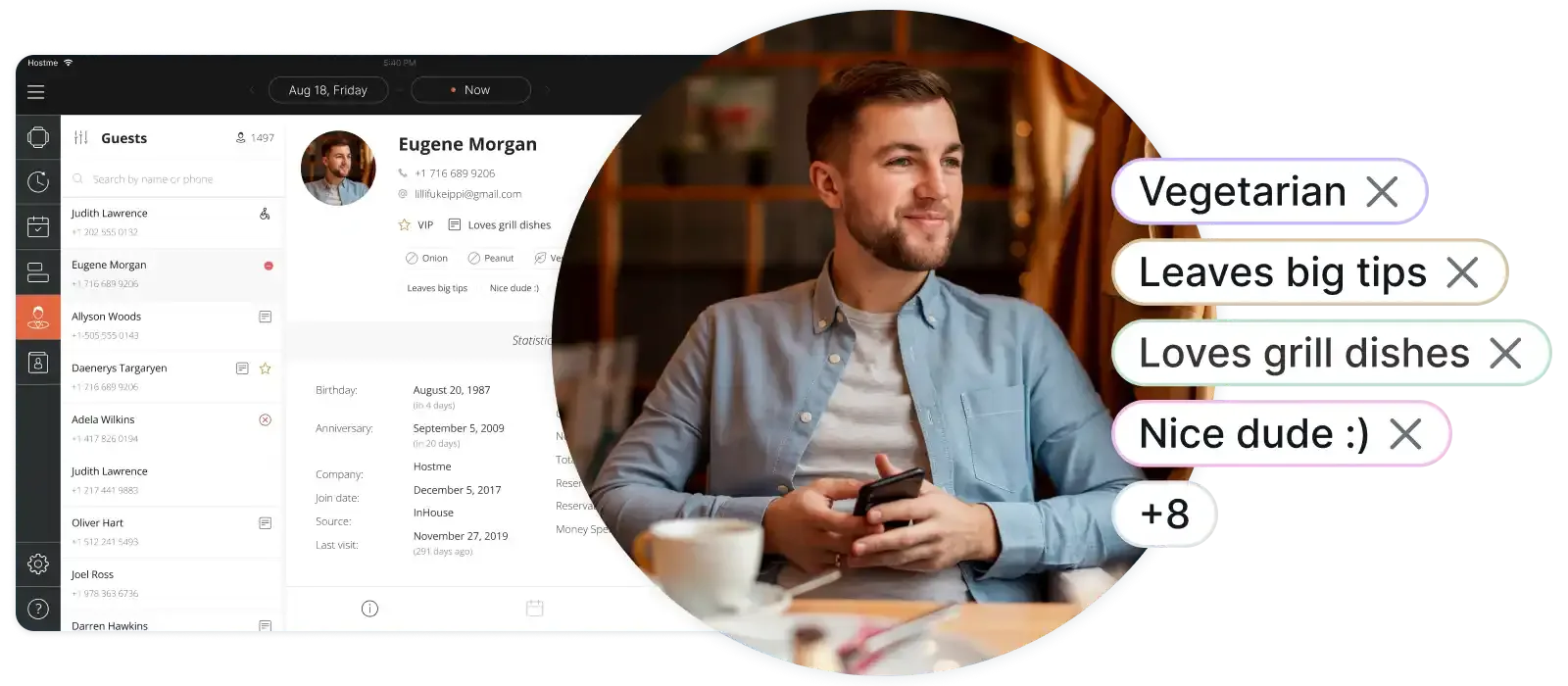
Your guest data belongs to you and only you. When a guest makes a reservation or joins your waitlist through Hostme, their information goes into your private Guestbook. Hostme never shares that data with third parties and never uses it for any marketing other than what you decide to do with it. Your regulars, their preferences, their visit history, that's yours to build on.
You can reach them directly with Marketing Campaigns. Once you have that guest data, Hostme makes it easy to act on it. You can send personalized campaigns by SMS, email, or WhatsApp directly from the platform. No extra tools required. Want to fill a slow Wednesday night? Send a targeted offer to guests who haven't visited in 30 days. Launching a new menu? Let your regulars know first. The campaigns are simple to set up and the results are yours to keep.
You can capture pick-up orders without the fees. Hostme's Online Ordering feature lets your guests order for pick-up directly through your own channel pacing orders to match your kitchen's capacity and keeping the commission in your pocket instead of DoorDash's. For a restaurant doing meaningful pick-up volume, this alone can recover thousands of dollars per month.
The goal isn't to pull off third-party platforms overnight. It's to build a parallel, owned channel that grows stronger every month so you're never entirely dependent on someone else's platform for your best customers.
A Practical Starting Point
You don't need to overhaul everything at once. Here's where most independent restaurants start:
1. Start capturing guest data at every touchpoint. Every reservation, every waitlist add, every pick-up order is an opportunity to add someone to your own database. If you're not doing this, you're leaving the most valuable asset of your business on the table.
2. Enable direct pick-up ordering. Even converting a small percentage of your third-party pick-up orders to direct orders starts compounding fast. Customers who place an online order directly with a restaurant visit 67% more frequently than those who don't. (Lightspeed, 2026)
3. Run your first direct campaign. Start simple. A thank-you message to recent diners, a birthday offer, or a slow-night promotion. The point is to start using the relationship you have rather than renting one from a platform.
4. Measure the shift. Track what percentage of your orders are coming through direct channels vs. third-party over time. Even moving from 10% direct to 25% direct can meaningfully change your bottom line.
The Bottom Line
Third-party delivery platforms helped the industry survive some very hard years. They're not going away, and for most restaurants, they shouldn't go away entirely.
But the restaurants that will thrive in 2026 and beyond are the ones that use those platforms strategically while building something they actually own: a direct, loyal relationship with their guests.
Your food built that loyalty. Your team earned it every night. It's time to make sure it belongs to you.